
How Lusion built oryzo.ai
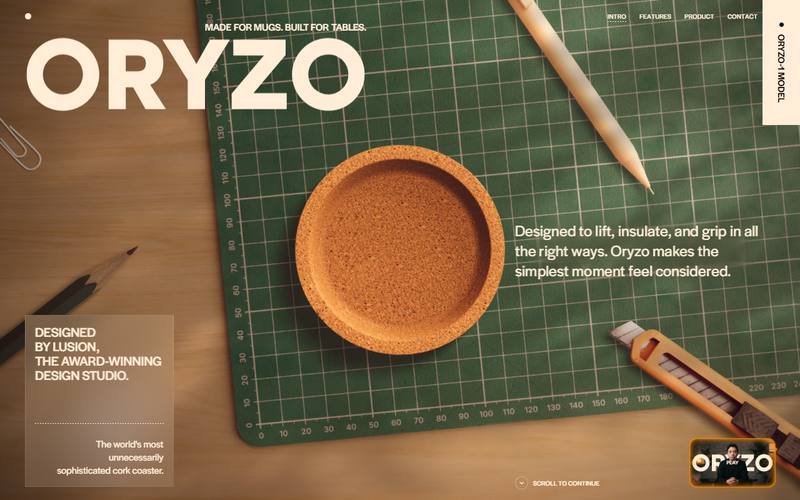
Lusion's product site for Oryzo is almost entirely custom GLSL. The uniform names describe the techniques: blue noise, gobo lights, a fluid paint trail and an LMS colour grade.
 Visit oryzo.ai ↗
Analyze it yourself →
Color palette
Click a color to copy its hex. Wider means more of the page.
Analysis
The colour that appears most often on oryzo.ai’s landing page is #FFEDD7, a pale orange. The strongest accent is #DC5000, a saturated orange. Its darkest and lightest colours, #100904 and #FFEDD7, have a contrast ratio of 17.3:1, which passes WCAG AAA for body text. 2 of the colours are chromatic; the other 1 is a neutral.
The page is set in 2 font families: halyard-display-variable and Arial. 1 other gallery site also uses it (nike.com). halyard-display-variable is outside the 100 typefaces in our font database and used by no other gallery site, so among the 107 sites we measured it is unique to oryzo.ai. Check the foundry’s licence before using it.
Measured running on the page: Three.js. For context, Three.js runs on 17 of the 107 gallery sites (16%).
It finished loading in 3.3s in our browser, 1.6s slower than the gallery median of 1.7s. The landing page carries 39 images (median 44) and 22 links (median 119). It publishes no JSON-LD structured data, which search engines use for rich results. It links to 4 social profiles: X / Twitter, Instagram, LinkedIn and GitHub.
How the hero is built
Six canvases on WebGL2 compile 68 shaders, 34 vertex and 34 fragment, and none of them carries a three.js SHADER_NAME. Every material is custom. Eight shaders sample a blue-noise texture (u_blueNoiseTexture, with a per-frame u_blueNoiseCoordOffset) to dither gradients so the dark, warm backgrounds don't band.
The light falling across the product is a gobo: four shaders take u_goboTexture, u_goboMatrix, u_goboProjectionMatrix, u_goboOpacity and u_goboParams, a texture projected like a theatre light through a patterned plate. Another shader is a paint simulation: u_prevPaintTexture, u_drawFrom, u_drawTo, u_pushStrength, u_vel, u_dissipations, u_curlScale and u_curlStrength describe a pointer-driven trail pushed through curl noise that fades each frame. Colour runs through an LMS-space lookup (u_lmsTexture) with a saturation control.
Scroll drives the scene through uniforms rather than DOM animation. Earlier captures across 12 scroll stops (in the table below) show the hero shader fading out in the first ~9% of the page, a blur falling from 86 to 0, and the clear colour moving from near-black to cream; this run found the uniforms that would carry that blend: u_clearColor, u_clearColorRatio and u_bgColor0/1.
The DOM type system is unusual. Sizes are tokens multiplied by a --screen-unit, min((100vw − 6.25vw) / 1800, 100vh / 1024 × 1.25), so type tracks both width and height: --h1 is 164 units, --h2 68, --body1 38. The display face is Halyard Display (variable, 100–900), with Literata and DM Mono self-hosted. The palette is warm: --color-black #100904, --color-white #FFEDD7 cream, --color-orange #DC5000, browns #382416 and #6C5F51, greens #445231 and #5D6C49. The video frame glows with four stacked inset orange shadows.
Measured values
| Renderer | three.js on WebGL2; all materials custom GLSL |
|---|---|
| Canvases | 6 (1920×1080) |
| Shaders | 68 (34 vertex / 34 fragment) |
| Dithering | blue noise on 8 shaders (u_blueNoiseTexture, per-frame coordinate offset) |
| Lighting trick | gobo projection: u_goboTexture / Matrix / ProjectionMatrix / Opacity / Params |
| Pointer effect | paint/fluid trail: u_prevPaintTexture, u_pushStrength, u_dissipations, u_curlScale, u_curlStrength |
| Colour grade | LMS lookup texture (u_lmsTexture) + u_saturation |
| Type scale | --screen-unit tokens: h1 164, h2 68, h3 45, h4 32, body1 38, body2 24 |
| Grid | 16 columns, gap = 24/90 of a column, 3.125vw side padding |
| Fonts | Halyard Display variable (100–900); Literata, DM Mono self-hosted |
| Colours | #100904, #FFEDD7, #DC5000, #382416, #6C5F51, #445231, #5D6C49, #F6E0C6 |
| DOM motion | 3 CSS animations (button pulse 1s, dash loop 1s); no animation library on window |
What we couldn't see
- Draw calls weren't counted.
- This run didn't re-read the scene graph. The mesh, triangle and scroll-stop figures in the deep-capture table below come from an earlier capture (2026-09-29), not today's.
- No GSAP, ScrollTrigger, Lenis, Framer Motion or AOS global; the scroll choreography is custom code driving shader uniforms.
Measured 2026-10-16 on https://oryzo.ai with Enrichr's reverse_engineer_webgl, extract_scene_graph, reverse_engineer_animations and extract_design_system tools, at a 1920×1080 viewport. Values come from one page load and change when the site does.
Deep capture
Captured with Enrichr's WebGL, scene-graph and animation tools. The kind of detail a screenshot can't show:
| 3D library | Three.js (WebGLRenderer, sRGB output, pixel ratio 1) |
|---|---|
| Scene size | 68 objects, 35 meshes, 35 materials, 2 cameras |
| Geometry | about 334,500 triangles / 123,800 vertices in the scene |
| Shaders | 68 captured shader sources; every material is a custom ShaderMaterial or RawShaderMaterial |
| Canvases | 6 |
| Rendering techniques (from shader uniforms) | blue-noise dithering, temporal jitter (TAA-style), light-field volumes, image-based lighting, a Gaussian-splat renderer, skinned/bone-weighted meshes, thermal and smoke effects |
| Scroll choreography (measured across 12 scroll stops) | hero shader ratio fades 1 to 0 in the first ~9% of the scroll; blur radius falls from 86 to 0 over 27-55%; thermal effect runs 46-55%; a peel/transition ratio goes 0 to 1 over 64-73%; background color shifts from near-black to cream over 55-73%; final clear-color blend at 91-100% |
| Animation libraries | None detected (no GSAP, Framer Motion, Lenis or AOS); motion is driven from custom code |
What we detected
| Detected animation / 3D libraries | Three.js |
|---|---|
| Fonts | halyard-display-variable, Arial |
| Mobile-ready | Yes (viewport meta present) |
| Structured data (JSON-LD) | Not found |
| Social profiles linked | X / Twitter, Instagram, LinkedIn, GitHub |
| Images on landing page | 39 |
| Links on landing page | 22 |
| Load time (our browser) | 3.3s |
Checking a site that isn't in the gallery? Paste its address into the free website font finder to see every font it uses, with weights and fallbacks, or into the color palette extractor for its colors.
Use this palette as CSS variables
:root {
  --oryzo-color-1: #FFEDD7;
  --oryzo-color-2: #100904;
  --oryzo-color-3: #DC5000;
  --oryzo-font: "halyard-display-variable", system-ui, sans-serif;
}
Rebuild something in this style with Claude
Paste this into Claude Code, Claude, ChatGPT or Cursor with Enrichr connected. It borrows the system, not the content: your copy, your brand, oryzo.ai's rhythm.
Use Enrichr to extract the design system from https://oryzo.ai.
Write tokens.css from the captured values (palette, type scale,
spacing, radii, easings), then build a hero in that style using
my own copy. List anything you had to guess.
oryzo.ai design FAQ
What font does oryzo.ai use?
oryzo.ai's landing page loads halyard-display-variable, Arial. A font you can see on a site is licensed to that site, so check the foundry's terms or pick a free alternative before using it yourself.
What colors does oryzo.ai use?
The most used colors on oryzo.ai's landing page are #FFEDD7, #100904, #DC5000, ranked by how often they appear in the rendered page.
Does oryzo.ai use GSAP, Three.js or another animation library?
Yes. We detected Three.js running on the landing page.
How do I get oryzo.ai's full design system?
Connect Enrichr to Claude, ChatGPT or Cursor and ask for the design system of https://oryzo.ai. It captures the rendered page and returns the full token set (type scale, spacing, radii, easings) plus animation timings and any WebGL shaders.
Try it free — your first analysis is on us →
Related sites
Captured 2026-09-29 from the site's public landing page. Only publicly observable information is shown, and it can change as the site does. All names and trademarks belong to their owners; Enrichr is not affiliated with oryzo.ai.